

From the Parisian salons of the 1970s to the humid streets of Singapore, the history of Balayage is a story of rebellion, chemistry, and the pursuit of the "un-done" look.
The atmosphere of innovation: Inside the golden era of French hairdressing.
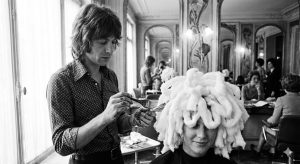
It is 1974. The air in Paris smells of Gauloises, expensive perfume, and the sharp tang of ammonia. Inside the hallowed halls of the Carita Salon—the epicenter of French beauty where Catherine Deneuve might be seen crossing her legs in the waiting area—a quiet revolution is taking place. A colorist named Yvan is staring at the back of a client’s head, a brush in his hand, dissatisfied with the rigidity of the status quo.
At the time, hair coloring was a game of geometry. It was about caps, hooks, and eventually, the crinkle of aluminum foil. It was precise, mathematical, and frankly, artificial. Yvan wanted something that mimicked the anarchy of a summer spent on the French Riviera. He didn't want stripes; he wanted whispers.
He reached for a pot of lightening paste and, instead of locking the hair away in foil, he began to paint. He started at the nape, lifting fine strands with the delicacy of an Impressionist painter attacking a canvas. To separate the sections, he didn't use harsh metals. He used cotton. By the time he had finished the head of his client, Miss Weston, she appeared to be wearing a cloud—a massive, sculptural wig made of 1,300 feet of cotton wadding stripping.
The result was not just a color; it was a movement. This was the birth of Balayage au Cotton. Derived from the French word balayer, meaning "to sweep," it was the antithesis of the rigid highlighting trends of the era. It was organic, fluid, and unmistakably chic.
Decades later, that moment of improvisation has become the most requested service in salons from New York to the high-end studios specializing in balayage Singapore has to offer. But to understand why this technique has held its reign for nearly fifty years, we have to peel back the layers of history, chemistry, and artistry that define it.
The Evolution of the "Un-Done" Look
In the early 1970s, the beauty standard was shifting. The structured, hairspray-heavy helmets of the 1960s were giving way to the free-spirited flow of the 70s. However, hair color technology hadn't quite caught up. The "Frosting Cap" was still ubiquitous—a rubber hat with holes through which strands were pulled and bleached, often resulting in a "spotted" effect at the roots.
When Yvan introduced his cotton technique at Carita, it was considered radical. The New York Times took notice. in a seminal article dated April 1, 1974, titled “Color Your Hair Simply, or Turn It Blue—Salons Can Do It All,” journalist Angela Taylor documented the shift. She described a world where hair was becoming an accessory of self-expression rather than just maintenance.
Yet, despite its revolutionary nature, Balayage remained a somewhat exclusive European secret for decades. The 1980s were dominated by the foil highlight—the era of high-contrast, chunky stripes that spoke to the loudness of the decade. It wasn't until the 1990s, when the "Supermodel" era ushered in an obsession with "expensive" looking, natural beauty (think Gisele Bündchen), that Balayage began to cross the Atlantic in earnest.
The Anatomy of the Technique
Why does Balayage continue to captivate us? The secret lies in the placement.
Unlike the foil method, which weaves hair into uniform sections from root to tip, Balayage is freehand. The colorist must possess a deep understanding of the head's curvature and the natural fall of the hair. It is less architecture, more sculpture. Freehand painting creates a bespoke gradient that foils cannot replicate.
"It requires a very precise as well as artistic placement strategy," notes a leading color director. "You have to look at the hair as a single fabric. Where would the sun naturally hit? Where do we need depth?"
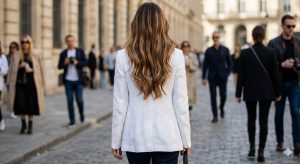
The application itself is a sensory experience. The colorist sweeps the lightening agent onto the surface of the hair strand, often leaving the underside untouched. This creates a soft gradient—darker at the root, diffusing into light at the ends. Because the lightener is exposed to the air (open-air processing) rather than incubated inside a heat-conducting foil, the lift is slower and gentler. This results in warm, golden, and beige tones rather than the stark, icy white often produced by foils.
This "surface painting" is what gives Balayage its signature "grown-in" look. There are no harsh lines of demarcation. As the hair grows, the shadow root extends naturally, meaning a client can go three, four, or even six months without a touch-up. In the fast-paced world of modern luxury, this low-maintenance aspect is not just a benefit; it is a necessity.
The Global Phenomenon: From Paris to Singapore
While the technique was born in Paris, it has found a fervent following in global fashion capitals, particularly in Asia. The demand for balayage Singapore residents generate is a testament to the technique's versatility.
In humid climates like Singapore, where frizz can often war with structure, the harsh regrowth lines of traditional foils can make hair look unkempt quickly. Balayage, with its soft diffusion, works with the texture rather than against it. It offers a "lived-in" luxury that suits the cosmopolitan, busy lifestyle of the city-state. Moreover, Asian hair, which tends to be darker and thicker, benefits immensely from the dimensional painting of Balayage. It allows for the introduction of caramel, mocha, and ash tones without the commitment of a full-head bleach.
It is a misconception that Balayage is reserved for the blondes of California. The technique is, in fact, color-blind. For brunettes, it creates "tortoiseshell" effects; for redheads, it adds ribbons of strawberry and copper; for raven-black hair, it introduces cool-toned slate or warm cinnamon swirls that catch the light.

Foils vs. The Paintbrush: The Great Debate
To understand the superiority of Balayage for the modern aesthetic, one must look at the alternative.
The Foil Method:
-
Process: Hair is woven and isolated in aluminum. Heat builds up, accelerating the chemical reaction.
-
Result: Uniform, symmetrical highlights from root to tip.
-
The Look: High contrast, often appearing "stripey" or overly saturated.
-
Maintenance: Demarcation lines are visible within 4–6 weeks.
The Balayage Method:
-
Process: Hand-painted surface application, often separated by cotton or plastic wrap.
-
Result: A gradient of color, bespoke to the individual's haircut.
-
The Look: Sun-kissed, organic, and fluid.
-
Maintenance: Seamless regrowth allowing for 3–6 months between appointments.
While foils have their place—specifically for those seeking a dramatic, high-lift uniform blonde—they often lack the soul of a hand-painted finish. Foils are science; Balayage is art.
The Modern Hybrid: Enter "Foilyage"
Fashion, however, never stands still. Just as Yvan disrupted the industry in the 70s, modern colorists are hybridizing techniques to push boundaries. Enter Foilyage.
For clients with very dark hair who crave the lightness of a platinum blonde but desire the gradient of Balayage, the traditional open-air painting might not provide enough "lift." The air dries the lightener, stopping the chemical process before the hair reaches the palest levels of blonde.
Foilyage solves this. The colorist paints the hair in the sweeping Balayage style but then wraps the painted section in foil or thermal sheets. This traps the heat and moisture, allowing the lightener to work harder and lift lighter, while still maintaining the soft, blended root application of traditional Balayage. It is the perfect marriage of 1970s artistry and 1980s power-processing.
The result: Effortless, sun-kissed dimension that mimics a summer on the coast.
The Psychology of the Highlight
Why do we color our hair? In 1974, it was perhaps an act of rebellion. Today, it is an act of curation. We live in an image-obsessed era where our digital avatars are as important as our physical presence. Balayage provides a texture and depth that translates beautifully on camera—it gives hair movement even when it is still.
There is also the "Rich Girl Hair" phenomenon. In a culture that increasingly values "stealth wealth"—luxury that doesn't scream—Balayage is the ultimate status symbol. It says, I spent money on this, but it looks like I didn't try. It mimics the hair of a child who has spent all summer playing on a beach in the Hamptons or the Côte d'Azur. It captures a moment of youth and ease, bottled (or rather, painted) by a skilled artisan.

Final Thoughts: The Cotton Legacy
When you sit in the salon chair today, scrolling through Instagram for inspiration, you might not see the ghost of Miss Weston and her 1,000-foot cotton wig. But the DNA of that moment is in every stroke of the brush.
Balayage is more than a trend; it is a philosophy. It is the belief that beauty should not be rigid, that imperfections are interesting, and that the best color looks like it grew out of your head that way. Whether you are in a high-rise salon in Singapore or a boutique studio in Paris, choosing Balayage is choosing the legacy of Yvan—a legacy of sweeping away the old to reveal the light underneath.
So, the next time you hesitate, worried that highlighting might be too bold or too damaging, remember: You aren't just getting highlights. You are wearing a piece of history.