

On the Spring/Summer 2025 couture runways, something shifted in the atmosphere. For decades, the golden rule of hair extensions was the "invisible blend"—the painstakingly applied keratin bond or the expertly hidden weft designed to deceive the eye. The goal was always to mimic nature, to whisper, “Yes, I woke up like this.”
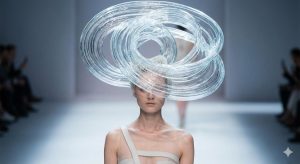
But watch the models at Schiaparelli or the architectural gravity-defying sculptures at Iris van Herpen, and you will realize that the whisper has become a scream. The era of the invisible extension is over. We have entered the age of Hair Architecture.
Suddenly, hair is no longer just a biological asset to be managed; it is a fabric to be manipulated. It is stiffened with resin, looped into alien halos, and extended into floor-grazing trains that have no intention of looking "natural." As we move deeper into a digitized, curated existence, hair extensions are evolving from a cosmetic secret into a prosthetic of identity—a shift that is taking us from the ancient temples of India to the biotech labs of Silicon Valley.
The Architecture of the Avatar
To understand why the aesthetic of "fake" hair is suddenly so chic, we must look at how we view our bodies. In the age of the metaverse and the Instagram filter, we have grown accustomed to treating our appearance as a customizable avatar. We embrace the "glitch."
Stylists like Evanie Frausto and Jawara Wauchope are arguably the new sculptors of this generation. They are treating synthetic and human hair not as a replacement for what is missing, but as a medium for what could be. When a model walks down the runway with a ponytail that defies the laws of physics, stiff and glossy as spun glass, it signals a kind of Transhumanist beauty. It suggests that the wearer has surpassed the limitations of biology.
"Hair is the only body part we can detach, modify, extend, and remove without surgery," says a leading avant-garde stylist backstage in Paris. "It is ephemeral. Today I can be Rapunzel; tomorrow I can be a pixie. It is the ultimate freedom."
This freedom, however, has historically come at a heavy, often silent, price.
The Temple Paradox
Beneath the gloss of the luxury salon lies a supply chain as old as it is complex. For decades, the "gold standard" of extensions has been "Virgin Temple Hair"—hair shaved from the heads of pilgrims in South India as a deeply spiritual act of tonsuring, a sacrifice of vanity to the gods.
There is a profound, uncomfortable irony in this exchange. A woman in Chennai shaves her head to detach herself from worldly beauty; that same hair is then bleached, processed, and sold to a woman in New York or London to enhance her worldly beauty. It is a transfer of spiritual energy that has become a multi-billion dollar commodity.
While many ethical companies work hard to ensure fair compensation flows back to these communities, the modern Vogue reader—hyper-aware of provenance and sustainability—is beginning to ask difficult questions. Is it possible to wear the hair of another human being without participating in an imbalance of power? As the appetite for length and volume grows effectively insatiable, the industry is hitting a supply wall. There are only so many donors.
The solution, it seems, isn't to find more donors. It’s to stop needing them altogether.
From Sourcing to Synthesis
If the 2010s were defined by "sourcing" hair, the late 2020s will be defined by growing it.
We are currently standing on the precipice of the "Biotech Hair" revolution. Just as the fashion industry has embraced lab-grown diamonds and mushroom-mycelium leather, the hair industry is looking to the petri dish.
Researchers at institutes like Rensselaer Polytechnic Institute have already successfully 3D-printed hair follicles within lab-grown skin tissue. While the technology is currently medical—aimed at skin grafts and alopecia treatment—the cosmetic leap is inevitable.
Imagine walking into a salon in 2035. You do not browse through bundles of hair sourced from a stranger across the globe. Instead, the stylist takes a swab of your DNA. A few weeks later, you return to have a set of extensions applied that are biologically identical to you. They possess your exact texture, your specific curl pattern, and your DNA signature.
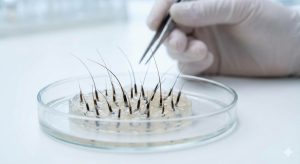
This is Keratin 2.0. It is cruelty-free, infinitely sustainable, and removes the murky ethics of the human hair trade. It transforms hair from a finite resource into an infinite material.
The Synthetic Symbiosis
Until that biotech future fully arrives, fashion is bridging the gap by embracing the "Hyper-Synthetic."
We are seeing a rise in high-quality, bio-based synthetic fibers that mimic the weight and movement of human hair but offer textures that nature never intended. Think of the "Liquid Hair" trend—strands so glossy they look wet, or colors that possess a metallic, fiber-optic sheen.
This is where the "Post-Human" aesthetic takes full flight. We are stopping the pretense that we are purely natural beings. By wearing obvious, structural, or bio-engineered extensions, we are engaging in a form of high-fashion honesty. We are acknowledging that in a world of AI and bio-hacking, "natural" is a fluid concept.
The Infinite Braid
The history of hair is a history of status. In Ancient Egypt, nobility braided gold into their wigs to signify closeness to the gods. In the Victorian era, lockets of hair were kept as sentimental tokens of immortality.

Today, as we clip in our 26-inch wefts or admire the sculptural updos of the couture season, we are part of that same lineage. But the narrative has shifted. We are no longer hiding the artifice. We are celebrating the architecture.

Whether it is sourced from a temple or synthesized in a lab, the ponytail of the future is not just an accessory. It is an extension of our potential—proof that we can design ourselves to be anything, or anyone, we desire. The body is just the canvas; the hair is the paint. And for the first time in history, the supply of paint is about to be infinite.