
I. The Olfactory Memory of Trauma
If you were to cut open the timeline of my life—and the lives of millions of women like me—you would count the rings not in years, but in hair traumas.
For the first two decades of my existence, my hair was not a body part; it was a problem. It was a chaotic entity that lived on my head, a thing to be managed, subdued, wrestled, and hidden. I remember the Sunday evenings of my childhood with a visceral, somatic clarity. I remember the smell—that distinct, acrid scent of "Blue Magic" grease hitting a hot comb. I remember the sound of the bristles tearing through tangles, a sound like ripping fabric. I remember the flinch.
But mostly, I remember the Pyramid.
For generations, the standard salon experience for a textured person was a lesson in gaslighting. We would walk in, hopeful. We would sit in the black vinyl chair, our feet dangling, and watch the stylist approach with a spray bottle and a fine-tooth comb. They would wet the hair. They would pull it taut, stretching the spiral until it lay deceptively flat against the cape. And then, they would cut a straight line.
To a stylist trained in the Euclidean geometry of straight hair, this made sense. A straight line is "even." A straight line is "clean."
But hair is physics, not intentions. When curly hair dries, it shrinks. But it does not shrink evenly. The hair at the nape of the neck, having a shorter distance to travel, hangs low. The hair at the crown, having to traverse the curve of the skull, springs up violently.
The result was the "Triangle of Doom." The Mushroom. The Shelf. I would leave the salon with a blowout I didn’t ask for, solely because the stylist needed to blow it straight to prove the cut was "even." For three days, I would look like a newscaster. Then, I would wash it. The water would hit, the illusion would shatter, and I would be left with a geometric shape that defied logic and beauty.
I spent my twenties apologizing for this shape. I internalized the idea that my hair was "bad," "unruly," and "unprofessional." I didn't know that the problem wasn't my hair. The problem was that I was trying to live in a world designed for lines, while I was made of circles.
II. The Era of the Chemical Truce (1950–1990)
To understand why the modern "Curly Specialist" salon is a holy site, we must first visit the purgatory that came before it. We must talk about the Era of Suppression.
For the latter half of the 20th century, the beauty industry waged a chemical war against texture. The weapon of choice was the Relaxer.
We often joke about it now—the "creamy crack"—but the reality was grim. We were applying harsh alkaline creams (often sodium hydroxide or calcium hydroxide) directly to our scalps. These chemicals worked by breaking the disulfide bonds—the very internal skeleton of the hair shaft—to force the strand to lie down.
We accepted the burns. We accepted the scabs. We sat in salon chairs with fire on our heads and tapped our feet, counting the minutes, because the pain was the price of admission to "society."
Why did we do it? Because the world told us that Volume was Vice. In the corporate boardrooms of the 80s and 90s, sleekness was synonymous with competence. Frizz was viewed as a lack of discipline. If you couldn't control your hair, how could you control a meeting? The salon industry reinforced this. Cosmetology schools used mannequins with straight synthetic hair. They taught graduation cuts and bobs based on straight-hair fall patterns.
If a curly client walked in, the "Master Stylist" would panic. They would chop into the curl blindly, thinning it out with razor shears to "remove bulk," leaving the hair frizzy and shattered. We were not clients to be pampered; we were obstacles to be overcome.
III. The Graveyard Under the Sink
This era of confusion birthed another universal experience: The Product Graveyard.
If you have textured hair, you know exactly what I mean. Open the cabinet under your bathroom sink. It is a dark, sticky place filled with half-used bottles. It holds mousses that promised "weightless definition" but delivered "crunchy ramen noodles." It holds jars of butter that claimed "intense moisture" but left you looking greasy by noon.
This graveyard represents hundreds, perhaps thousands of dollars in sunken costs. It exists because for fifty years, we were trying to solve a physics problem with chemistry. We thought if we just found the right "miracle gel," our hair would behave.
We were wrong. The problem wasn't the product. The problem was the architecture of the cut.

IV. The Digital Uprising and The Big Chop
The revolution didn't start in Paris. It didn't start in a high-end loft in Soho. It started on low-resolution webcams in bedrooms.
Around 2008, something shifted. The internet gave us each other. The rise of the "Natural Hair Community" on YouTube was a subterranean movement that exploded into the mainstream. Suddenly, women in London were talking to women in Atlanta. They were trading secrets. They were reading ingredient labels.
We learned a new vocabulary. We learned about sulfates (the enemy). We learned about silicones (the fake friend). And then, we faced the most terrifying term of all: The Big Chop.
I remember the day I did it. I stood in front of my bathroom mirror, scissors in hand, looking at three years of heat-damaged, chemically relaxed ends hanging off my new growth like dead weight. My hands shook. To cut your hair is one thing. To cut off your "safety blanket"—the length that you hid behind—is another.
I cut the first lock. It sprang up, tight and coiled, close to my ear. I cut another. And another. When I was done, I looked like a stranger. But I also looked, for the first time, like myself. This was the "Transition Phase." Millions of us walked around with half-grown Afros, twist-outs, and Bantu knots, trying to figure out who we were without the straight jacket.
But we had a problem. We had embraced our natural texture, but the salons had not. We would walk into luxury establishments with our new virgin hair, and the stylists would still reach for the blow dryer. "I can just smooth this out for you," they would say. "No," we said. "I want to wear it curly." The silence that followed was the sound of an industry hitting a wall.

V. The Schools of Architecture: Deva, Rezo, and the War on Pyramids
Necessity is the mother of invention. But in this case, trauma was the mother of innovation. A new breed of stylist began to emerge, and they brought with them distinct "schools" of architecture.
We moved from the "One-Size-Fits-All" era to the era of Methodology.
The First Wave: The DevaCut (The Pioneer) If there is a "Year Zero" for the modern curly movement, it belongs to the DevaCut. Born in New York City, this method was the first to widely commercialize the radical notion of cutting hair dry, in its natural state.
The philosophy was simple but ground-breaking: You wear your hair dry, so we cut it dry. The Deva method treats the hair like a waterfall. The stylist cuts curl by curl, following the cascading pattern of the hair. It was a revelation for definition. It taught us that disturbing the curl pattern while wet was a sin. It gave us the "waterfall" shape—layered, face-framing, and safe. It was the technique that convinced millions of women to put down the straightener.
The Second Wave: The RezoCut (The Volume Revolution) But as the movement matured, a new desire emerged. We didn't just want "defined" hair. We wanted BIG hair. Enter Nubia Suarez and the RezoCut.
While the DevaCut was about "taming and framing," the RezoCut was about Liberation and Levitation. The Rezo philosophy addressed a specific pain point: How do I get massive volume without losing my length? In traditional layering, to get volume on top, you had to cut the top layers short, which often left the bottom looking thin. The Rezo technique uses a different geometry—often described as "circles within circles" or "stars."
It elevates the hair from the root. It is designed to move. It is the cut of the "Rumba." It allows a woman to flip her hair from left to right with zero resistance, maintaining a perfect, rounded silhouette from every angle. If Deva was the polite introduction, Rezo was the unapologetic main event.
The Technicians: Carving and Slicing (The Ouidad Method) Running parallel to these was the Ouidad method, often called "Carving and Slicing." While Deva and Rezo focused on the shape, Ouidad focused on the density. This method involves cutting vertical sections of hair while wet (or damp) to remove the "internal bulk" that causes the triangle shape. It allows curls to puzzle-piece together rather than stacking on top of each other.
Why This Matters Why is it important to know these names? Because for the first time in history, we have a menu. We are no longer walking into a salon praying for "anything but a disaster." We are walking in with specifications.
-
"I want the volume of a Rezo, but the elongation of a Deva."
-
"I need the internal weight removal of a Ouidad carve, but the dry-finish of a Diamond Cut."
We are no longer passive recipients of a haircut. We are the creative directors of our own crowns.
VI. Hydro-Physics: The Death of the Towel
The second pillar of this revolution was the understanding of water. For my entire life, I was told to towel-dry my hair immediately. I was told that water caused frizz. The new science proved the opposite: Water is the only moisturizer.
Frizz is not a texture; frizz is a cry for help. Frizz is a curl reaching out into the atmosphere, searching for moisture because it doesn't have enough inside the shaft. The modern curly salon taught us the "Squish to Condish" method.
It sounds unglamorous, but it is magic. You stand in the shower, hair soaking wet, coated in conditioner, and you cup your hands and squish the water into the curls. You hear a sound—a distinct, wet squelch. That sound is hydration penetrating the cuticle.
We learned to style our hair soaking wet. We learned to apply gel to hair that was dripping, locking the water inside a "cast" as it dried. We learned that the towel was the enemy, robbing us of the hydration we needed. We switched to microfiber, to old cotton t-shirts, to air drying. We stopped fighting the water, and started worshipping it.
VII. The Global Laboratory: From New York to Singapore
It would be a mistake to think this is just a Western trend. The Curly Renaissance is a global phenomenon, and in many ways, the tropical regions are leading the charge.
Why? Because of the Final Boss: Humidity.
It is easy to have a great hair day in the dry heat of Arizona or the mild climate of Southern France. The true test of architectural integrity is the equator. This is why the Southeast Asian market has become a fascinating laboratory for curl science. In a region where the air is thick with moisture, the "straight blowout" is a fool's errand. It lasts ten minutes before the moisture in the air reverts the hydrogen bonds in the hair.
We are seeing a massive surge in specialized education in these zones. There is a new standard for the luxury curly hair salon Singapore women are flocking to, mirroring the boutique studios of Paris and New York. In these humidity-dense capitals, the cut must be perfect. A stylist cannot hide behind a flat iron here. They have to cut a shape that allows the hair to swell, to expand, to breathe with the atmosphere.
They are teaching women that "big hair" is not "messy hair." They are reframing the "frizz halo" not as a failure, but as an ethereal, romantic texture that softens the face. They are proving that you can be polished, professional, and powerful, even when the dew point is 75 degrees.
VIII. The Psychology of Taking Up Space
Ultimately, the evolution of the curly hair salon is about something much deeper than keratin. It is about Sovereignty.
Think about the psychological messaging of the "tamed" look. For centuries, women were told to be small. To be quiet. To be contained. Straight hair is vertical. It takes up very little visual space. It stays within the lines. Curly hair is horizontal. It expands. It is radial. It takes up room. It blocks the view of the person sitting behind you in the movie theater. It catches the light. It demands to be seen.
The old salon experience was about apologizing for taking up space. It was about "thinning out" the bulk. It was about reduction. The new salon experience is about Amplification.
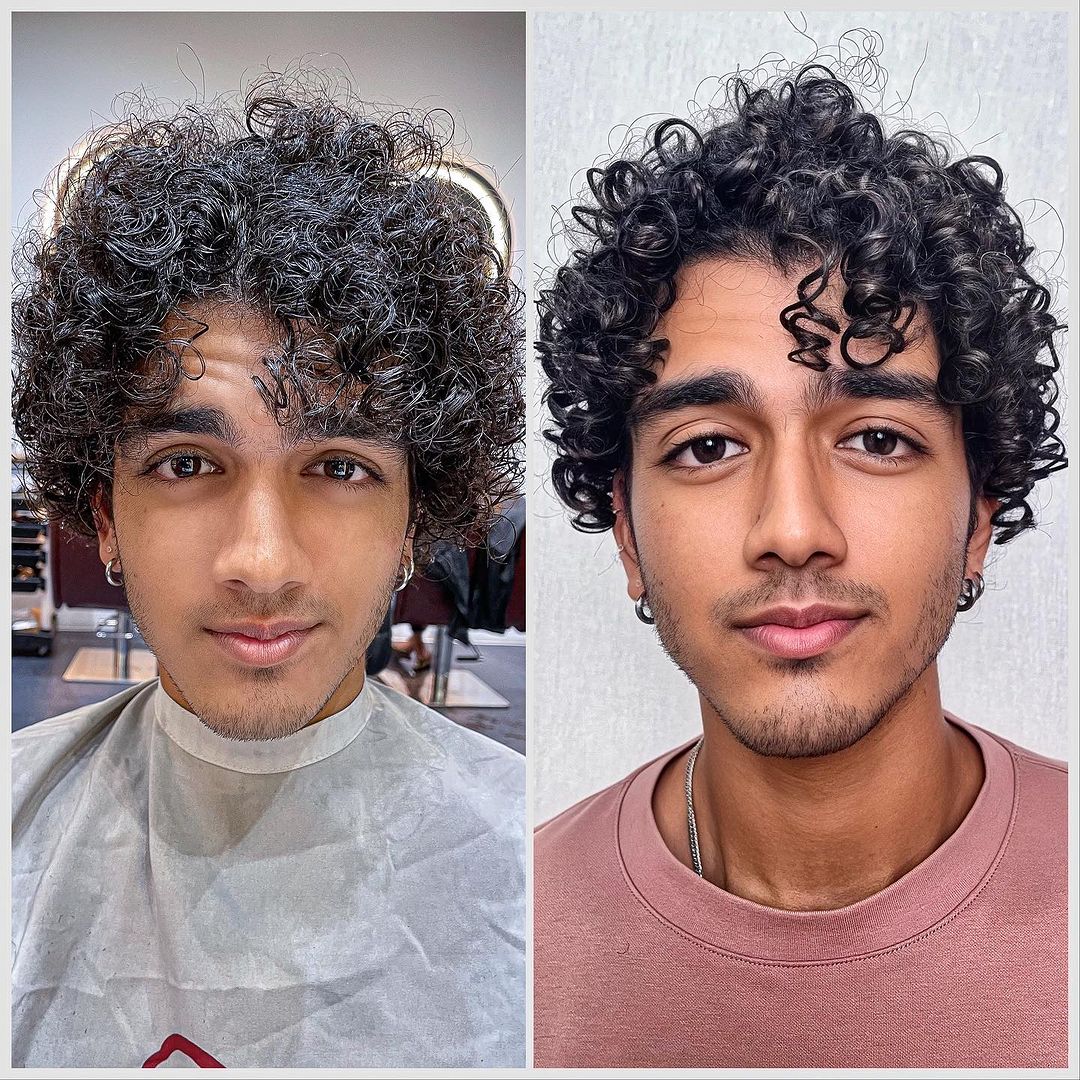
The Mirror Moment There is a moment that happens at the end of a Dry Cut that makes every dollar worth it. The hair has been cut dry. It has been washed, hydrated, and diffused. The "gel cast" has been scrunched out to reveal soft, bouncing ringlets. The stylist spins the chair.
I have seen women weep in this moment. They are not crying because they look pretty. They are crying because they look free. They are seeing a version of themselves that they were told didn't exist. They are seeing their natural texture—the hair that grows out of their scalp—looking healthy, shiny, and intentional.
They realize, in that flash of the mirror, that they didn't need to be fixed. They didn't need to be flattened. They just needed to be understood.
IX. The Verdict: A Love Letter to the Coil
So, is it worth it? Is it worth flying to a different city to find a specialist? Is it worth paying double the price of a standard cut? Is it worth throwing away the "Product Graveyard" under your sink and starting over?
Yes. It is worth it because you are not just buying a haircut. You are buying back your time. You are buying back your Sunday mornings. You are buying the freedom to walk into a meeting, or a date, or a rainstorm, and feel completely at home in your own body.
We have finally put down the hot comb. We have stepped away from the sink. We have stopped asking for permission to exist. The architecture of the coil is not a mistake. It is a masterpiece of nature—strong, flexible, defying gravity, and spiraling upward.
The future of the salon is not about changing who we are. It is about celebrating who we have always been. And for the first time in history, the view from the chair is beautiful.